



Crazy Paving vs Traditional Pavers for Outdoor Spaces

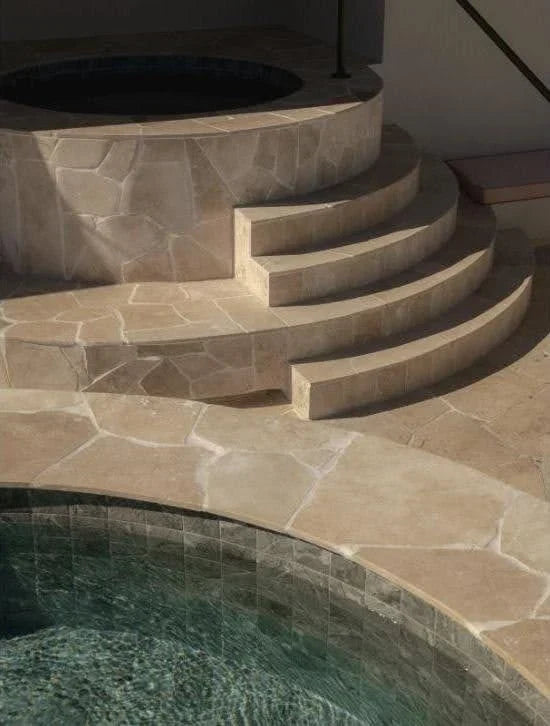
Travertine crazy paving around a spa and pool edge, where the irregular joints read as organic rather than uneven.
Crazy paving is natural stone laid in irregular, fragmented pieces rather than uniform rectangles, fitted together like a puzzle with narrow mortar joints running between each piece. Traditional pavers are the opposite: consistent shapes, straight joints, a grid you can predict from three metres away.
Both are legitimate ways to pave an outdoor space, and the right one depends on the look you're after and how much of the joint pattern you want doing the visual work. Crazy paving reads as organic, established and a little less formal, the sort of surface that looks like it's always been there. Traditional pavers read as considered and architectural, with the straight lines doing a lot to define the space.
Below is a straight comparison of the two, current crazy pave pricing from Casa Della Casa, and the practical installation differences that tend to catch people out.
Crazy Paving vs Traditional Pavers: The Real Differences
| Crazy paving | Traditional pavers | |
| Shape | Irregular, fragmented pieces | Uniform rectangles or squares |
| Joint pattern | Organic, non-repeating | Straight, grid-based |
| Best suited to | Pool surrounds, garden paths, courtyards with curves | Driveways, formal patios, straight-edged areas |
| Installation labour | Higher; every piece is fitted individually | Lower; consistent units lay faster |
| Material waste | Lower; irregular offcuts are used, not discarded | Higher on curved or angled layouts |
| Visual style | Relaxed, Mediterranean, established-looking | Clean, formal, contemporary |
Where Crazy Paving Genuinely Wins
Crazy paving comes into its own on anything with a curve: pool surrounds, garden paths that bend around planting, stepping areas, or an organic-shaped courtyard where a rigid grid of pavers would need constant awkward cutting to follow the line.
Because the pieces are irregular by design, offcuts and smaller fragments get used rather than binned, which is a genuine cost and waste advantage on a curved layout compared with cutting rectangular pavers to follow the same line. We recommend a 20% wastage as opposed to the usual 15%.
It also ages well. A traditional paver with a chip or a stain stands out because every unit around it is identical. In crazy paving, the natural variation in size, tone and joint width means small imperfections simply read as part of the stone's character rather than a flaw.

The Casa Della Casa Crazy Pave Range
Current crazy paving stock, priced per square metre.
| Product | Price | Finish | Colour |
|---|---|---|---|
|
Classic Light Travertine Crazy Pave, Unfilled & Honed |
$110.00/m² |
Honed |
Beige |
|
Classic Light Travertine, Large Format Crazy Pave |
$115.00/m² |
Unfilled & honed |
Beige |
|
European Split Stone Crazy Pave |
$99.00/m² |
Split face |
Natural |
Installation: What's Actually Different
The material cost of crazy paving and standard pavers is often comparable, sometimes even in the paver's favour, but labour is where the two diverge. Every piece of crazy paving is placed and fitted by eye, balancing size, shape and joint width across the whole run, which takes a more skilled and patient installer than laying a repeating grid of identical pavers.
Budget for that labour difference upfront rather than being caught out at quote stage. It's the trade-off for a surface with no visible repeat and joints that follow the stone rather than a ruler.
-
Confirm your installer has specific crazy paving experience, not just general paving, since the skill is genuinely different.
-
Order slightly more material than a straight paver job, since piece selection and fitting involves more trial placement.
-
Choose a textured or split finish for pool surrounds and wet areas, for the same slip-resistance reasons that apply to any outdoor natural stone.
-
Confirm freight before ordering, since natural stone is heavy; Casa Della Casa provides a custom freight quote for bulk crazy pave orders.
The Quality Question: Why the Stone Itself Still Matters
Because crazy paving relies on irregular pieces, it's tempting to assume any stone will do. It won't. A dense, low-porosity travertine or limestone holds its finish and colour far better outdoors, under Australian sun and rain, than a softer or more porous import. Casa Della Casa's crazy pave range carries the same 7-year commercial warranty as the rest of the natural stone collection, and samples are available from $15 delivered so you can see the actual tone and texture before committing to a full pool surround or courtyard order.
Crazy Paving: Common Questions
Is crazy paving more expensive than traditional pavers?
Material cost is often similar, and crazy paving can even work out cheaper on curved layouts due to lower waste. The main cost difference is labour, since fitting irregular pieces by hand takes longer than laying a uniform paver grid.
Is crazy paving suitable for pool surrounds?
Yes, and it's one of the more popular applications for it in Australia. Choose a textured or honed finish with adequate slip resistance, the same way you would for any natural stone used around water.
Does crazy paving need sealing?
Most natural stone crazy paving benefits from sealing, particularly in high-moisture areas like pool surrounds, to protect against staining and reduce long-term wear on the surface.
Can I mix crazy paving with traditional pavers in the same project?
Yes, this is a common approach: crazy paving around curved features like a pool or garden bed, with straight pavers on adjoining formal areas such as a patio or driveway, using a matching stone tone to tie the two together.
What adhesive and grout do you recommend for a crazy paving installation with natural stone?
For the adhesive, we'd recommend Mapei Granirapid White. We suggest using white rather than a grey adhesive, as it's less noticeable if there's any bleed-through from the natural stone. Being a premium rapid-setting adhesive, it also helps minimise moisture-related issues such as colour bleeding.
For the grout, we'd recommend Mapei Keracolor GG. It's well suited to crazy paving installations, where the joints tend to be larger.
Ready to Choose Your Tiles?
If your outdoor space has any real curve to it, a pool edge, a garden path, a rounded courtyard, crazy paving is worth pricing against straight pavers before you commit. Order a sample or two to check tone and texture against your own space first.
Shop the range: Crazy Paving collection
Read more
Choosing a tile shouldn't be complicated, but with so many materials, finishes and formats available, it's one of the most common questions we get asked: "What tile can I actually use where?" The a...
A kitchen renovation lives or dies on the small decisions: tile size, grout colour, the sheen on the splashback. Ask ten people what makes a kitchen look expensive and most of them will point at t...
Leave a comment