



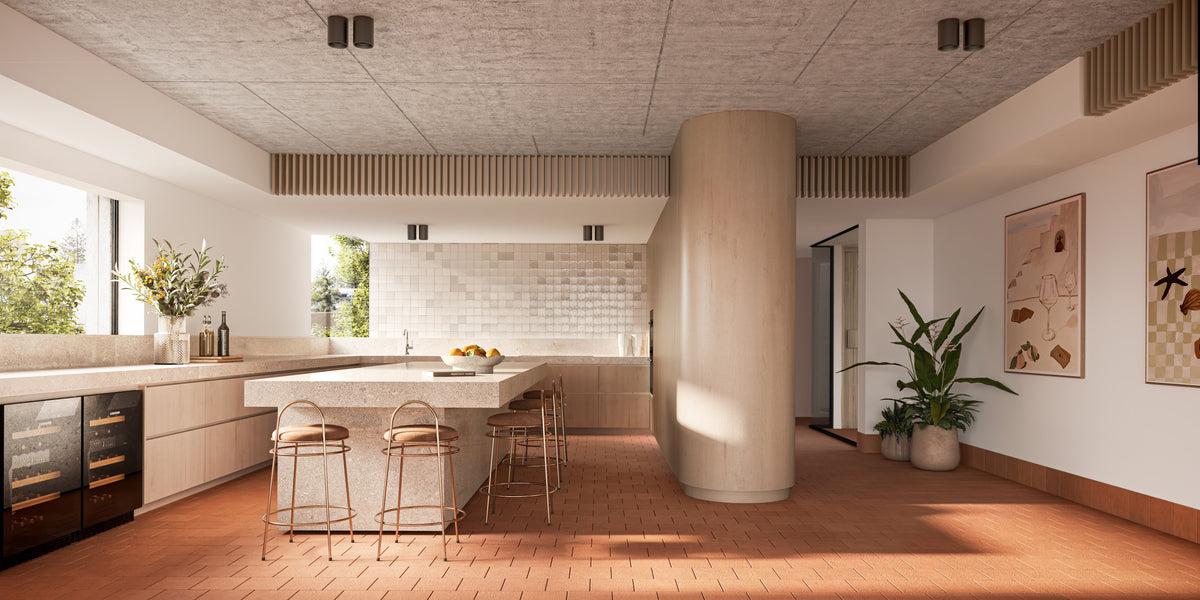
Terracotta, Revisited
From Tuscany to Miami - and why this centuries-old material is having a moment again
There’s something about terracotta that never really dates.
Not in the way trends come and go. Not in the way finishes cycle through phases.
Terracotta has always been there, quietly consistent, used in buildings that were never trying too hard.
Recently, I was in Tuscany - Chianti, to be exact. Most people know it for the wine and the landscape. But it’s also where Italian terracotta began.
Where it starts
Standing in the factory, you see how little has changed.
Clay, water, fire - and time.
The process is slow, deliberate, and largely unchanged for centuries. The tiles are shaped, dried, and fired in a way that gives them their variation - the tonal shifts, the imperfections, the texture you just can’t replicate with anything else.
That’s the point.
It’s not supposed to be perfect.
A material with history, still relevant now
Terracotta has been used across Italy for centuries - in homes, public buildings, courtyards, and streets. It’s durable, but more importantly, it feels right.
There’s a natural warmth to it. A softness.
It doesn’t try to dominate a space, it settles into it.
That’s why we’re seeing it come back. Not as a trend, but as a return to materials that feel considered and grounded.
From Tuscany to Arrivé, Miami
One of the projects we supplied is Arrivé in Miami, designed by Richards & Spence.
Over 3,000m² of terracotta, all sourced from Chianti.
It’s used across exterior, and internal floors and walls, alongside over 500m² of zellige-look tiles and custom seagrass limestone elements for the pools, benchtops and vanities.
More than 100,000 individual tiles have been installed on this project alone.
And what stands out isn’t just the scale - it’s how it’s being used.
Terracotta, when applied with architectural intent, is hard to beat. It brings a natural calm to a space. It softens hard lines. It creates a feeling that’s difficult to achieve with more manufactured materials.
Why it works
We’re seeing terracotta specified more and more - across both large-scale projects and residential builds.
There are a few reasons for that:
- It has depth - no two tiles are the same
- It ages well - it gets better over time, not worse
- It works across spaces - floors, walls, indoors and out
- It brings warmth - without feeling heavy or dated
It’s one of those materials that makes a space feel resolved.
What to know before using terracotta
Terracotta is natural, and that comes with a few considerations.
It’s porous, which means it needs to be sealed properly depending on the application. Maintenance is straightforward, but it’s different to porcelain or other low-maintenance surfaces.
Like most natural materials, you can also see some efflorescence (a white salt residue) appear after installation. This is normal and typically removed as part of the builder’s clean, often using a light acid wash.
Once cleaned and sealed correctly, it settles in and performs as intended.
That said, when it’s specified and installed properly, it performs incredibly well.
We’ve put together a care and maintenance guide to make that side of things clear - from sealing through to cleaning and long-term care.
Why we keep coming back to it...
For us, terracotta represents what Casa Della Casa is about.
The business was born in Italy, so materials like this have always been part of the foundation.
Materials with history.
Sourced properly.
Used in real projects.
Not trend-driven, just good materials, used well.
We’re seeing more architects and builders come back to it, not because it’s new, but because it works.
And when you see it come together on a project like Arrivé, you understand why it’s lasted this long.
Explore our terracotta, custom sizes also available or order samples online to see it in your space.
Leave a comment